Learning Ukulele 50 Sites Top 50 Ukulele Sites Argapa Ukuleles - one size louder: 2025

Tuesday, November 11, 2025

Reso [sort of] done

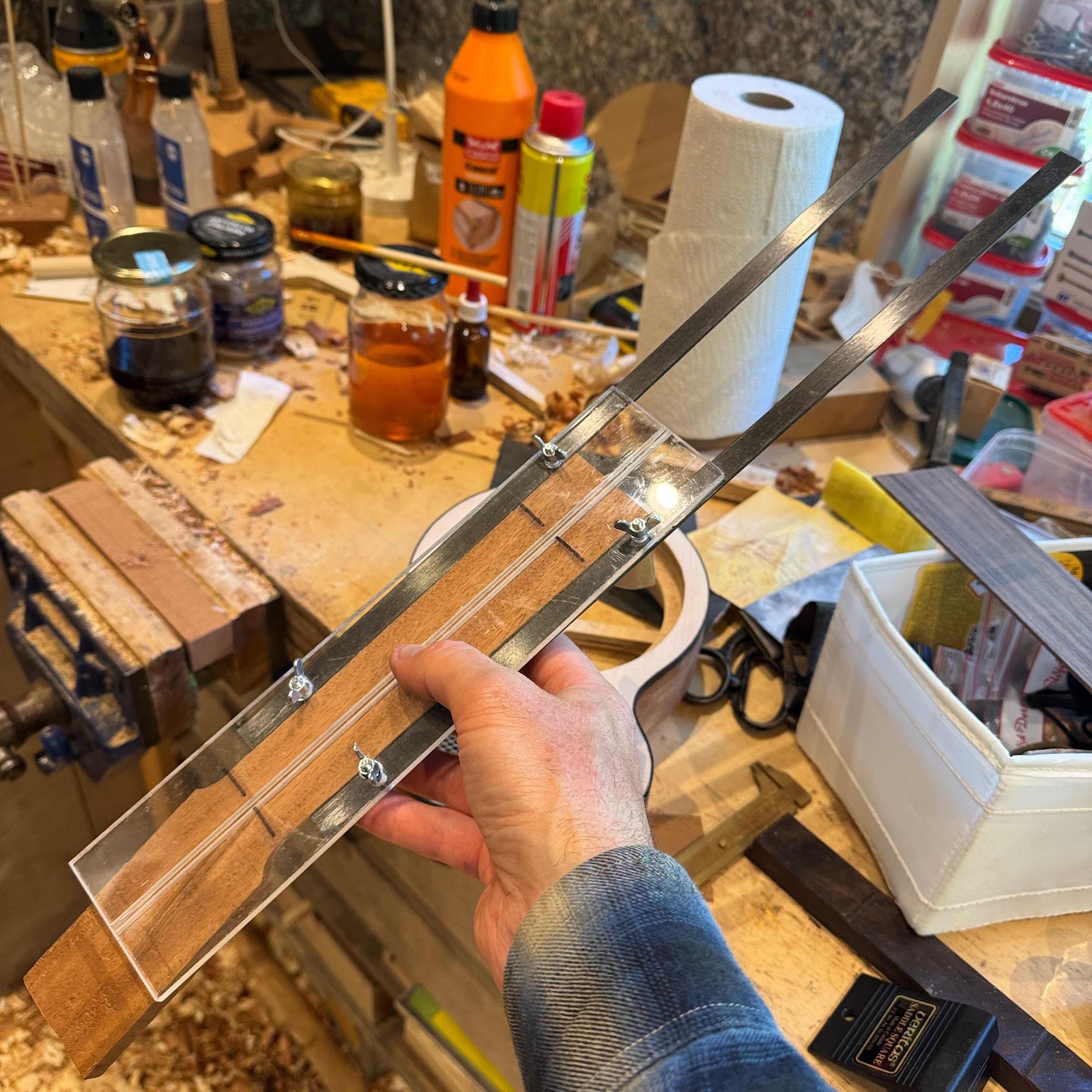
Hiya! In between travels I hunkered down in the workshop for a bit to wrap things up. First up was marking the screw holes for the cover plate, using my clear acrylic template. I have no idea why some words seem to be links.


There is a controversy regarding padding under the cone, some use felt, some prefer using nothing. I use rubber, thinking of it as a speaker cone and those usually hang in flexible material. 


And here you can see the ring of rubber at the bottom of the well. 


I check the bridge for an ok string height, which I leave on the high side for these. A reso sounds best when you spank the strings I think, closely followed by it being played by someone other than me.


The bridge gets notches for the strings and swoopy bits for intonation, the C-string needs to be a tad longer. 


A look at the list says this is number 128!


And I’m really pleased with how it turned out. Headstock is my preferred shape, with offset tuners and the rough-sawn sides (I should tell the buyer that), inlays on the fretboard turned out super, and the spruce / mahogany combo is really elegant. But wait - what’s that dark spot at 10 o’clock by the coverplate? It’s a mark I made in the spruce and then tried to fill, invisibly. I kind of failed. 


Thursday, October 30, 2025

String holder


Hello again. Now I’m gonna wrap this one up and get it to a place where we can see whether or not I stil know what I am doing. So I retrieved a cone, a coverplate, a biscuit and some tuners from the stash, and then I realized I need to make a string holder. The punched key-holes in the cover plate are great if you want to shorten your strings quickly, but I have an old nailcutter for that. 

Fortunately I have some keys from and old pedal organ. One of them will do nicely. 


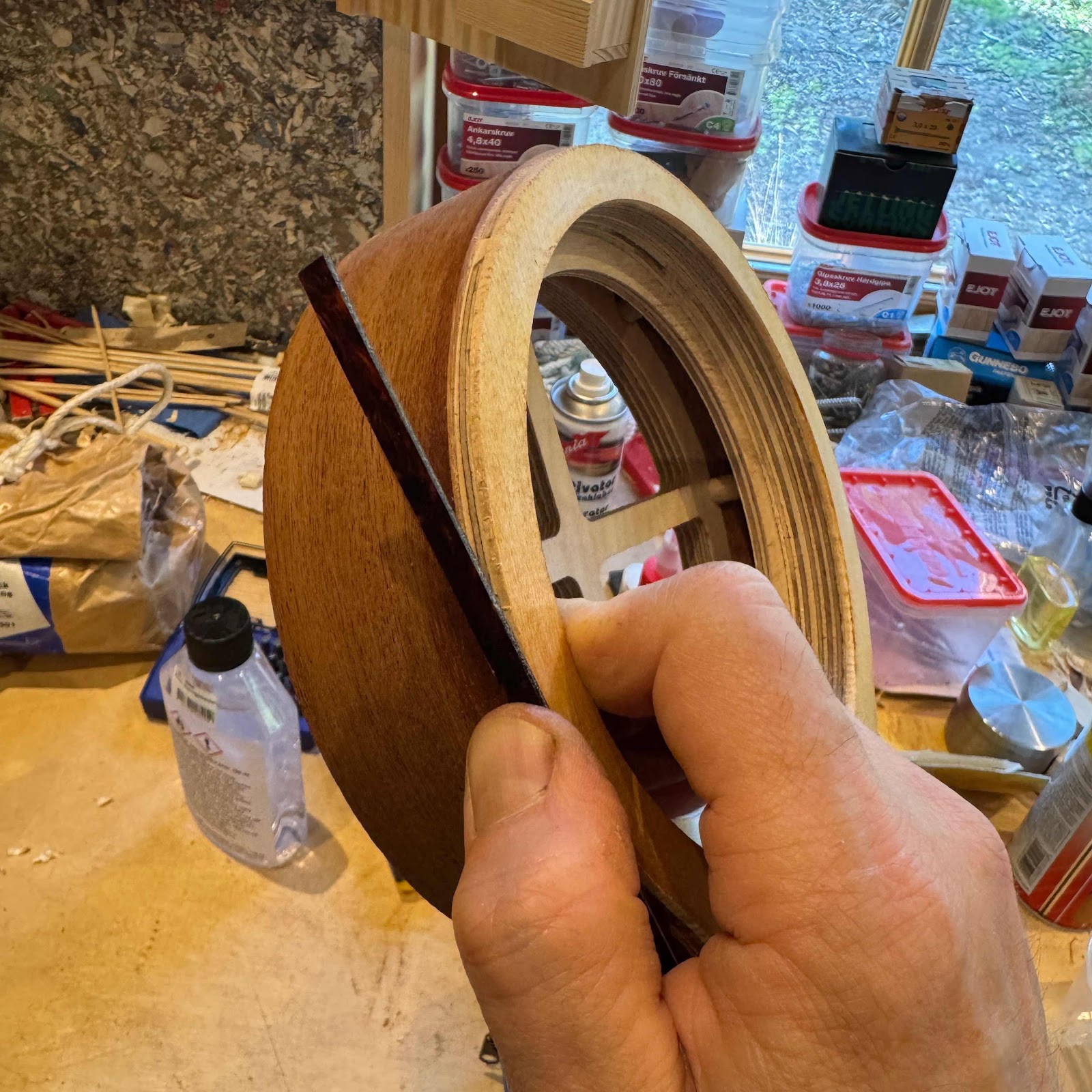
Before I cut it to length I scrape the underside to make it fit the coverplate.


After cutting it I try to shape the new end so it matches the original one, then I mark the position of the holes and drill for screws. 


This is the way it is attached. I will drill holes for the strings tomorrow. 

This post was made on my phone but the app I usually make them in has stopped working. So it might look a bit rough. 

Monday, September 22, 2025

Life sign from the workshop

Man alive the day job did a number on me and my time spent in the shop. Suddenly it was mud August and I had to start commuting to town and also some rather strange places abroad. 

I was surprised when I started on this uke by how many things I did remember when it came to techniques and methods, but I seem to have lost some of my touch when it comes to finishing. I have been struggling a bit with the French polishing, and I still need a few more coats before I can move on to buffing it out. 

That said, it does look rather nice wouldn’t you say. 


Friday, August 15, 2025

Starting finishing

Hell-o, now there will be a few posts showing the equivalent of paint drying. I started out with a few coats of shellac brushed on with a soft brush, then with that as a base I continued with the polishing process. 


(The book in the photo is a very good read but serves mostly as a prop to boost my credibility.)


French polishing is a wonderful process and at the same time a rather intimidating rabbit hole. I have developed a technique that I think works for me, but question it constantly. Mostly because of the amount of shellac, everything I’ve read measures the shellac in drops to be applied to the muneca, I tend to use a bit more. But as I said, it works. 


Thursday, July 31, 2025

Fretboard pt. 2

I am lagging behind a bit in reporting the progress, all these pics are a few days old but what can one do. 

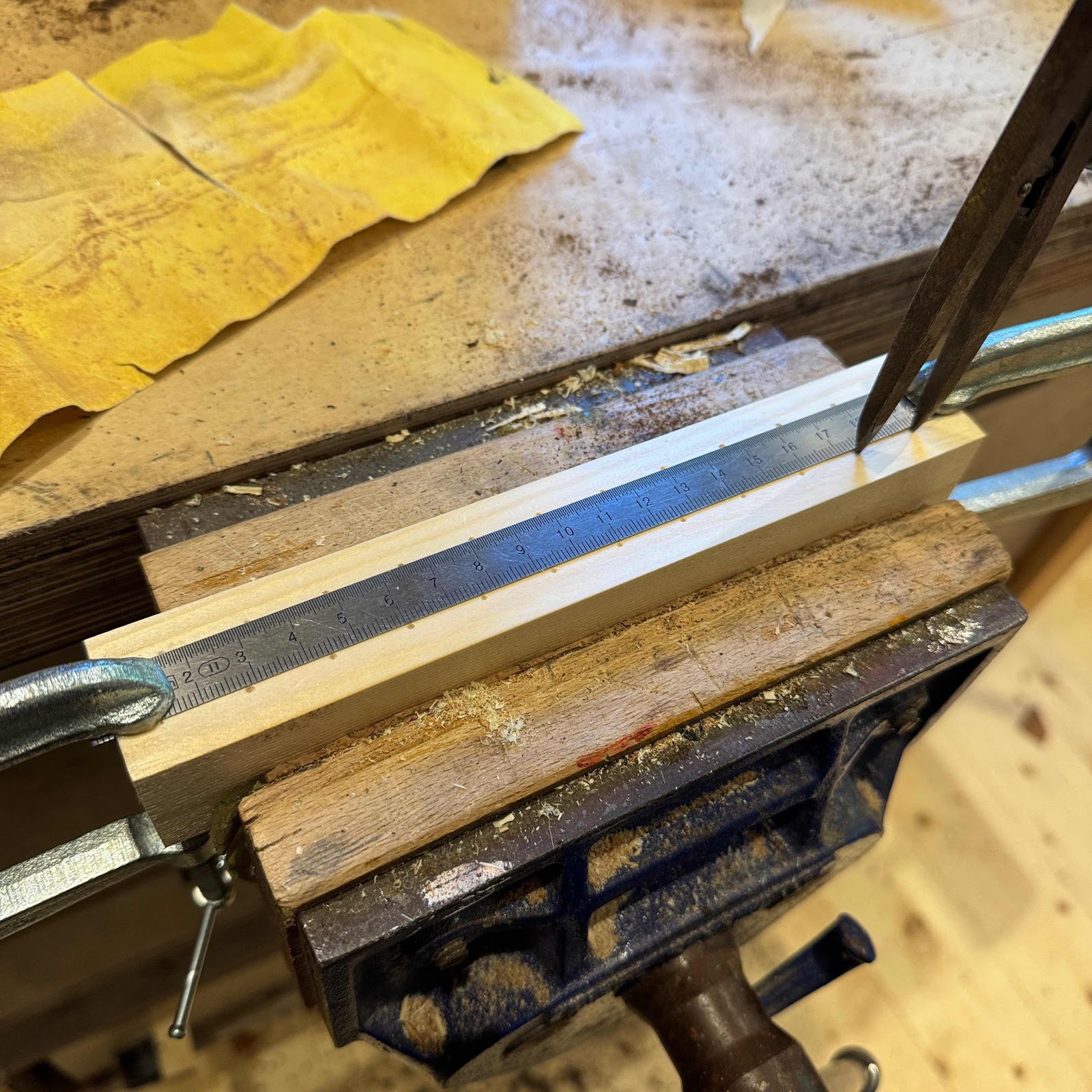
First pic is me laying out positions for some holes, using a very nice pair of dividers with a split nut. You need a few of these, trust me. The rule is just to keep the lines straight. 


Then over to the miniscule drill press, a Proxxon. So much better than a Dremel I hesitate to even compare them, but the latter has an industry standard thread at the front, allowing different adapters to be used. 


But what’s it for? For storing frets. I will cut the tangs back a bit, the weather’s warm and a bit humid so I foresee the fretboard shrinking a bit in the future. And then it’ll be much easier to knock back the ends if the tangs aren’t protruding. All this means I need to keep the frets sorted by length. 


Somehow (I know how) I missed taking a pic of actually cutting the tangs with my Stewmac fret nipper, but I’ll show that next time. Next pic shows me clamping a fret in using my version of a Jaws press. 


And once again aligning the board with rulers…


… before clamping it in place. 


Saturday, July 26, 2025

Fretboard pt. 1

I’ve been mucking around a bit with the fretboard while waiting for glue to dry in other places, now I have loads of progress to share. I’ll split it into two installments. 

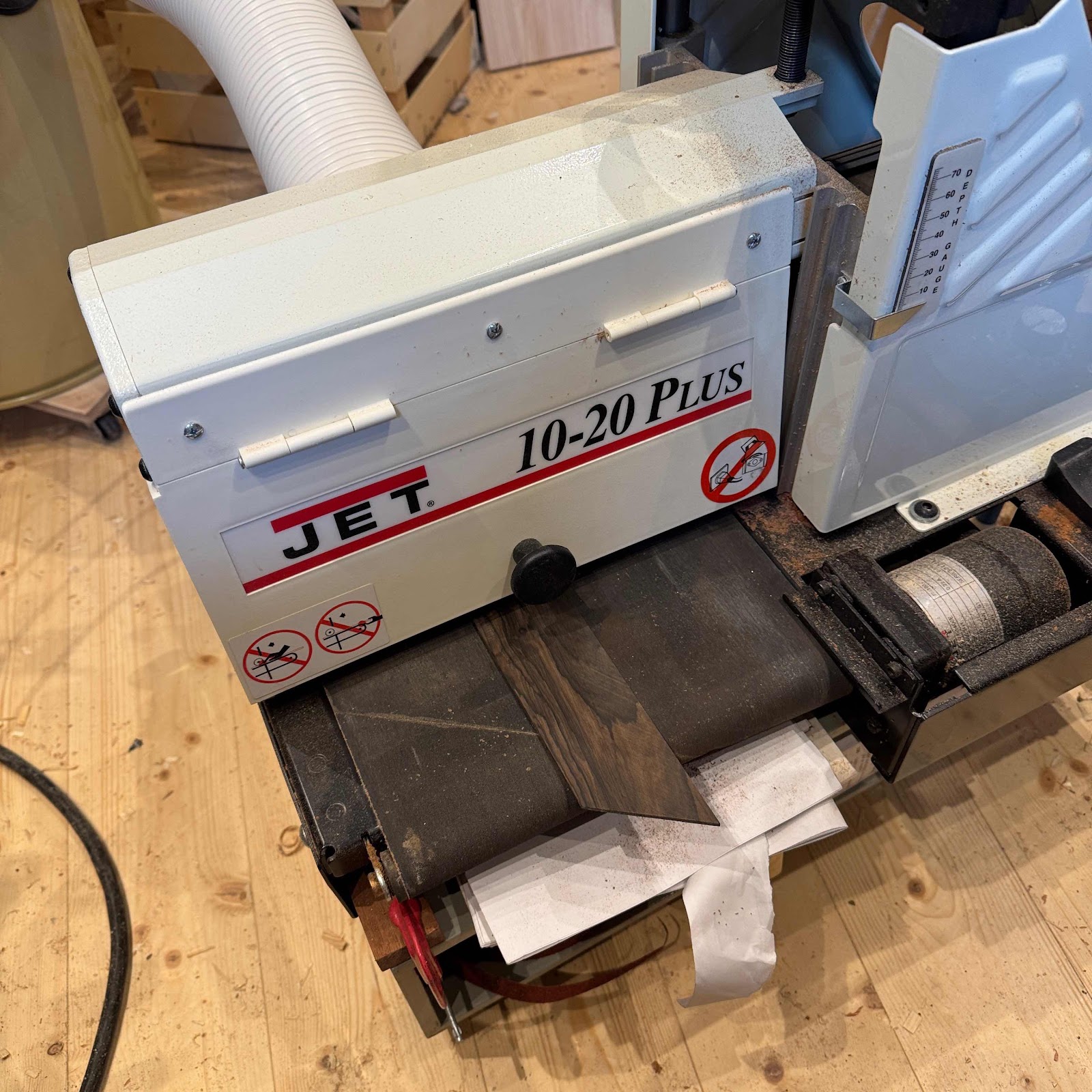
First pic is the rosewood board running through the drum sander. It was close to thickness already so I just needed the marks from the bandsaw to be gone. 


Then masking tape is applied to the underside of the board, and to the top of the fretboard. CA-glue holds the strips of tape together and everything in place. 


It was fiddly to set the depth stops to the exact depth, and the same depth, but I managed. I remember buying this expensive bit of kit from Stewmac, three weeks after the purchase they released their upgraded model with bearings and knurled thumb screws. I was fuming then and if I’m completely honest I’m still fuming. 


See? This is what we want. 


In a flash of inspiration I came up with the pattern for the inlays. I drill straight through and use plastic rods that I cut flush with a chisel. 


And sawing to width and the correct taper. The edges were planed after sawing. 


And this is where I’ll leave you for now. Fretting is underway and I dare promise that post will be gripping. 


Tuesday, July 22, 2025

Back glued on

It was time to glue the back on. I cut it out a bit oversized and aligned it with some small cleats from a kerfed lining strip. 


Then the glue was applied and spread out with the wee roller. In the back you can see a piece from an extra skeleton, to be used as a clamping caul. 


A rare shot of the Argapanator himself, thanks to me having company in the workshop for once. 


With a layer of foam I found kicking around and that skeleton half as the caul I clamped it up. 


And some excess glue was cleaned off and removed. Paralell to this I got cracking on the fretboard, but that’ll come in the next post. Fanx for reading!


Monday, July 21, 2025

Neck attached

Once I had some trouble aligning a neck, and in handling that situation I rigged this gizmo up. Haven’t used it loads but as I found it the other day I thought I could give it a go. If nothing else it captures on photo what I usually do by eye and loosely held rulers. 


I put a wee centre finding rule at the end of the body with the zero at the centre line, then I can more easily measure the position and direction of the neck. 


Before this last pic there were a few steps that aren’t possible to show, not because they’re classified but because they require both hands and some jiggling. But it all turned out well. Next up is chopping the excess at the heel off, glueing on the back and get cracking on the fretboard. 


Monday, July 14, 2025

Neck work

Time to get a handle on this situation, innit. I found an old mahogany neck blank kicking around and it will be a great match for the body. First pic is from measuring and marking out. 


Then I start carving with a two-handle drawknife, wicked sharp. I can’t find the neck carving jig, it must still be in a box somewhere. But the vise I got from Chris works. 


The knife goes down through the end grain like through [really dense and slightly brittle] butter. 


Trick photo - I can’t really carve holding the neck and the knife in the same hand, but wanted to show the shift to the wee knife for refining the shape and profile. 


I really like the faceted shiny surface from carving, but not all do so I finished it off with sandpaper. 


Are we fast approaching attaching the neck? I didn’t think I would remember this much but expected a lot more fumbling. Let’s hope this won’t jinx it. 

Friday, July 11, 2025

Binding

Hiya. The spruce top is on ans as I prömised I will bind it to protect the rather soft edge. A bit daunting as I haven’t done it in years, but I found the tools and the wee machine. Considered using the large trim router but opted for the Dremel with the Stewmac attachment. Sadly I forgot to take a pic of the setup, but it involves me sitting outside on a damp janky table clamping the uke between my knees and routing the channel slowly in several shallow passes. 

First pic shows the channel after a bit of cleanup with a file. 


The tortoloid binding is really stiff so I pre-bent it on low heat to get it to comply with the body shape a bit better. 


Doesn’t need to be any more precise than this although I suspect it could be. 


I used thick CA-glue. It works provided you rough up the inside surface a bit. I did that with a hacksaw blade, and I also chamfered the bottom inside corner of the binding strip with a knife so it doesn’t get in the wah of any microscopic pieces of crap in the channel. 

Low tack masking tape to make removal easier. It usually sticks rather well on account of the superglue. 


If you like it you should have put a string on it. I think.  


And after a couple of hours I dared remove the tape. Next up is scraping it flush to the top, then I guess I should start looking for a neck blank. 


Saturday, July 5, 2025

Soundboard (top anyway)

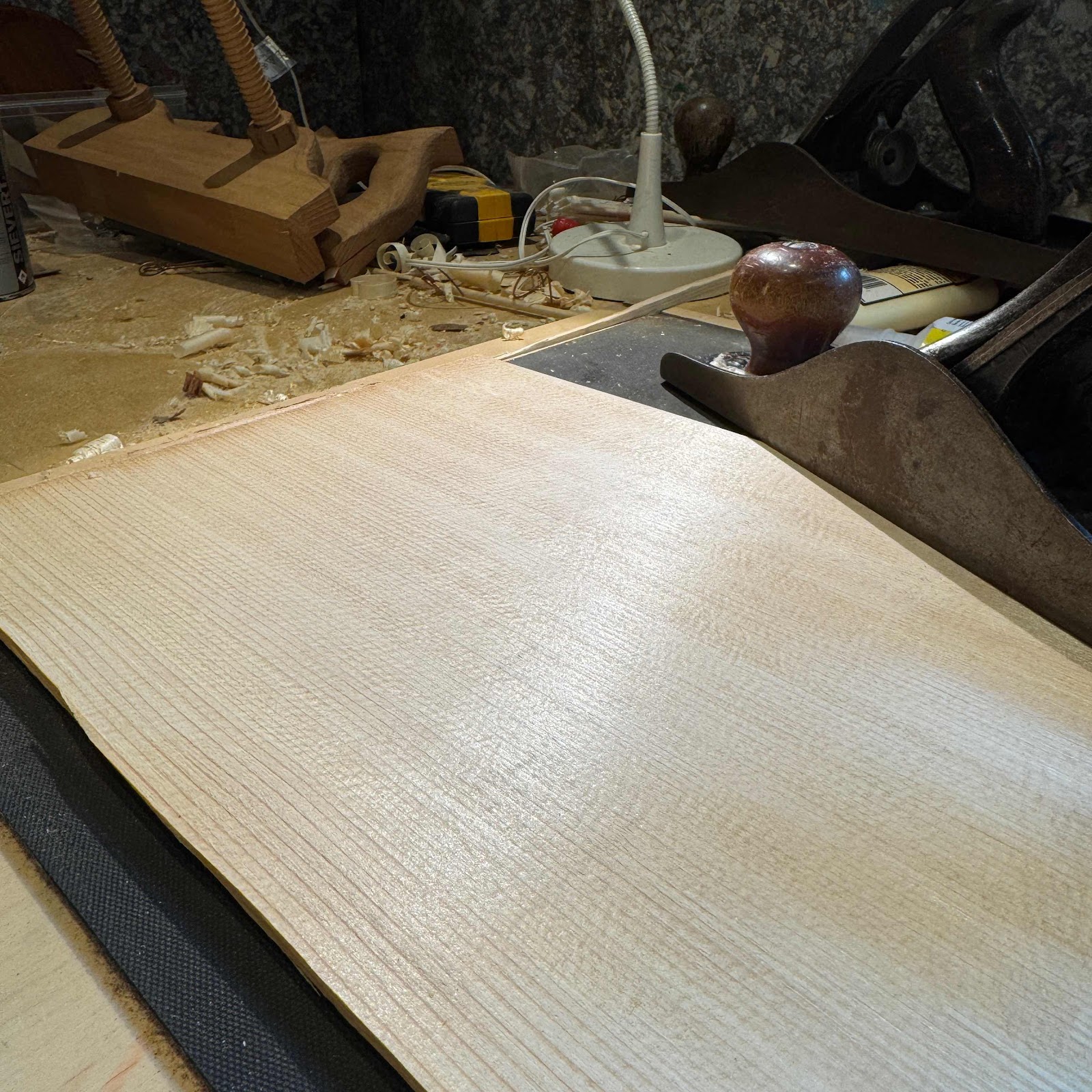
Hell-o, I’m back in Sweden after a stint in Mumbai and I’m back in the workshöp. My favourite customer S has been quiet lately, but he told me before that he considered a spruce top on the reso. I haven’t done that before so I’m game. Pic shows me planing it with a number 5 jack plane. 

It was a while since I prepared a top for a reso but I was confident I remembered the long and rather complicated sequence of steps <— foreshadowing


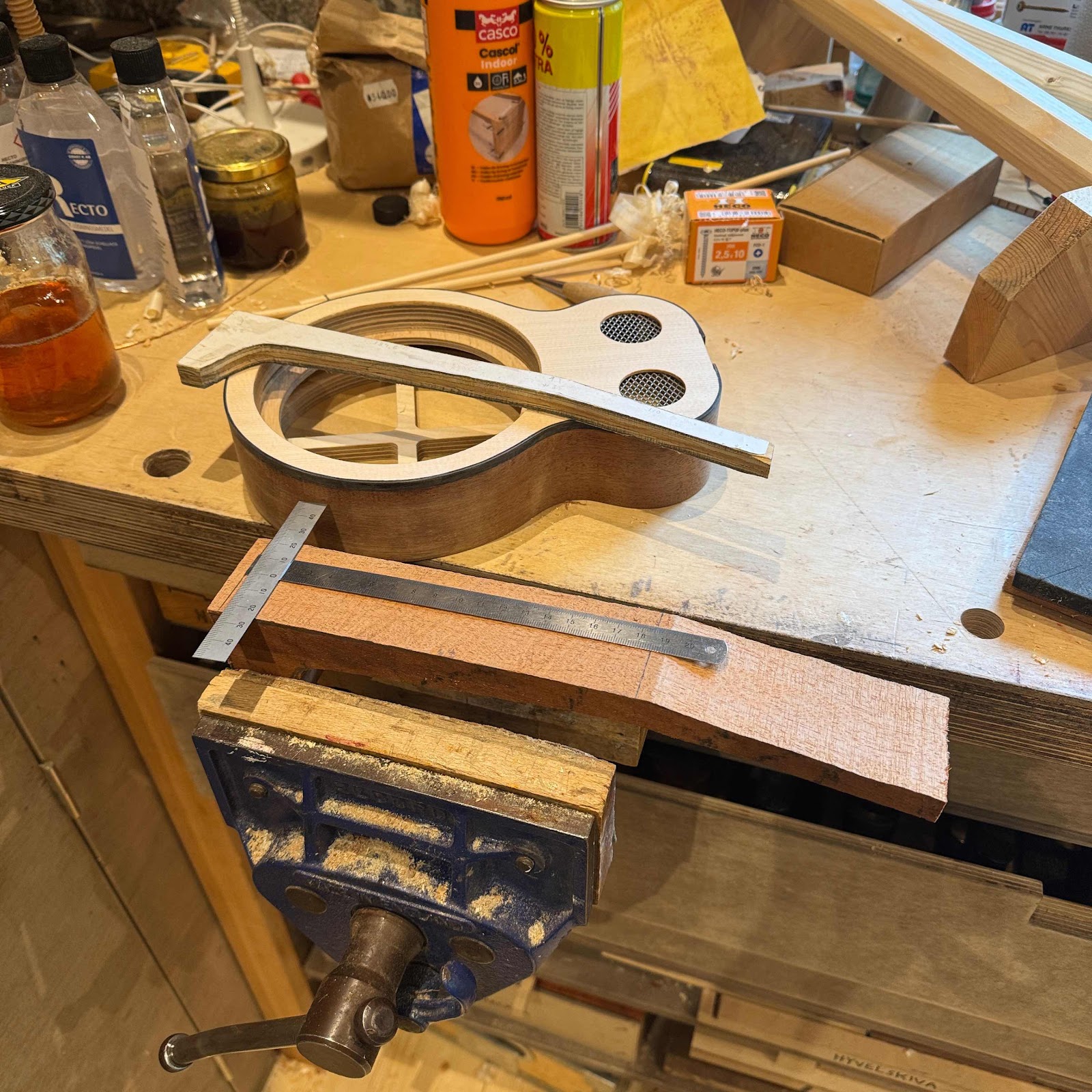
Then laying out the contour and marking for the holes. I’m really proud of my locating templates, the only easy way to find the center of the holes in the skeleton. 


And I get that the last pic doesn’t explain it totally so here’s another one that should help you out. 


And out came the marvellous rosette and circle cutter! Of course the holes should have been cut before I glued the wee locating nibs on. First mistake due to hazy recollections of ”the long and rather complicated sequence of steps”.


It’s possible to do it like this but next time I hope I do things in order. 


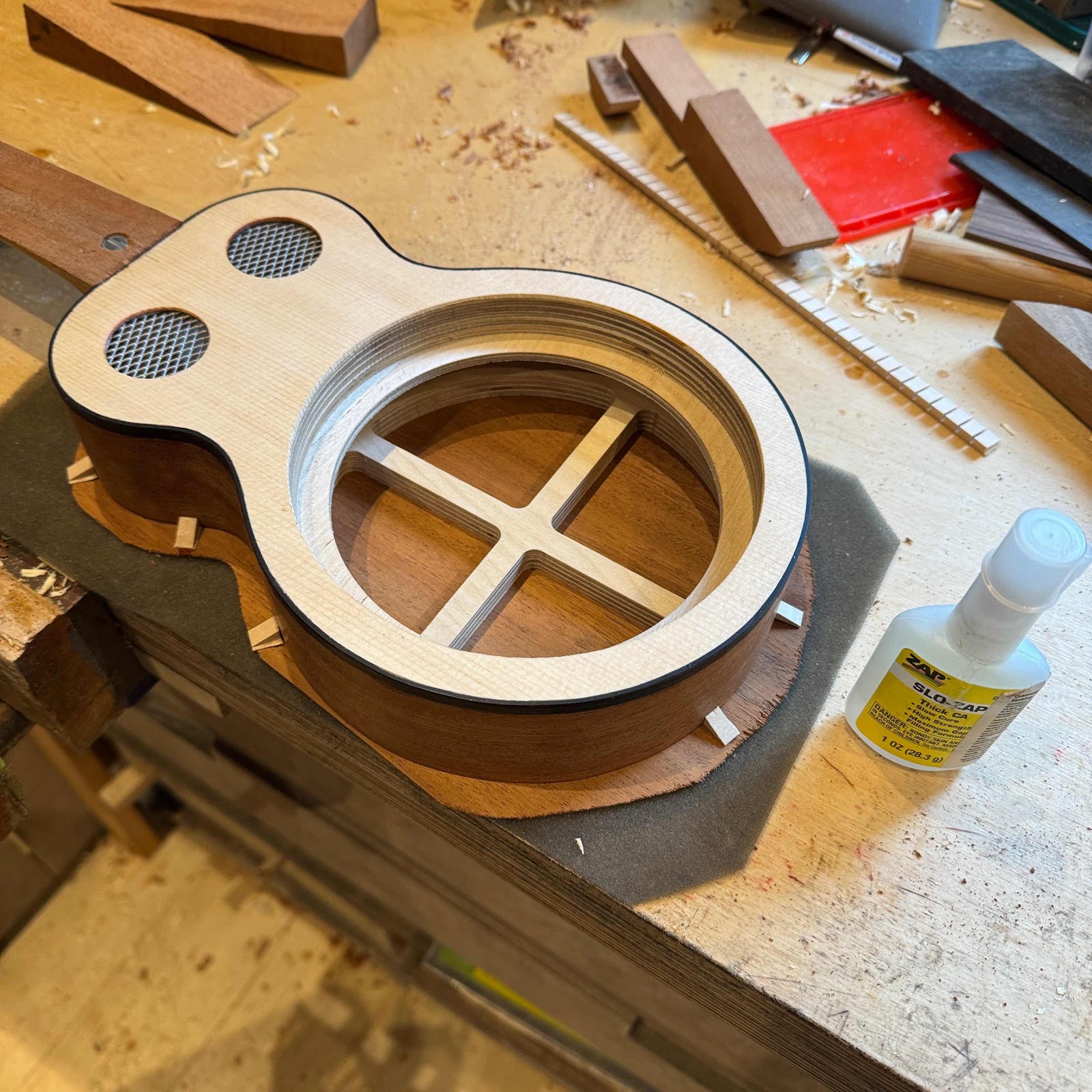
And on to mistake number three! (I won’t bother you with the second one but it involved sanding the edges of the holes before glueing the top on.) The third mistake was forgetting to glue the mesh screens in before the glue-up. But it went alright apart from poisoning myself with CA accelerator. 


And here is the result. Not much left of the spruce soundboard we started with but hey, it’s what’s needed. I will add binding as I tend to do with spruce topped instruments, leaning towards a single ply plastic one. But not black, that would be too stark a contrast. I hope I can find some tortoloid strips, they were around a mere four years ago.